



Introduction
“Nirthu ninte Porattu Natakam! (stop your Porattu Natakam already)” is a common Malayali phrase. In fact, it’s almost a command, asking the other to drop their silly, pretentious charade. This is what the term Porattu Natakam represents nowadays in Kerala’s public conscience. An insult that is now slowly dying out, but as an unfortunate irony, along with the passive memory of an art form that gave voice to the voiceless. In the uncertain fields of caste injustices and class discrimination, what Porattu Natakam gave the downtrodden of pre-modern Kerala was not just a humorous performance that masked their pain, but also a platform to showcase the heterogeneity of that pain to those who cared.
Origins of Porattu Natakam
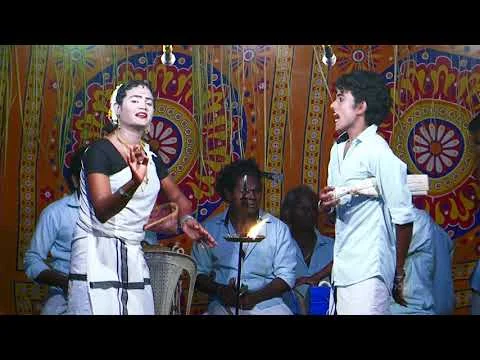
Porattu Natakam is mostly performed in the Palakkad and Thrissur districts of Kerala by the Panar community. It is believed that some version of this art form has been in existence for at least the past 170 years, but the origin of its modern iteration is attributed to Polpully Mayan. The community still venerates him as the father of the art form and sings his praises during the performances. The historical origins of Porattukali are also affected by the geopolitical history of the region. Since Palakkad was once part of the Madras Province, there is a distinct Tamil influence on the art form. It is believed that Porattukali borrowed abundantly from Tamil theatre traditions, specifically Therukoothu, which is considered its proto-form.
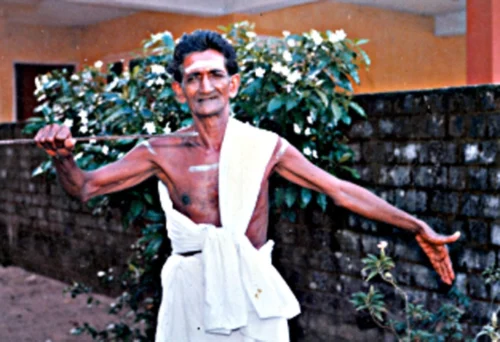
Regardless, the coming about of Porattu Natakam was very clearly a response to caste and class realities in Kerala at the time. The Panars, along with other communities like the Cherumar and Kuravar, were considered to be ‘untouchables.’ The obvious consequence of this social exclusion was a lack of privilege in terms of education, especially literacy in High art forms. As such, the Panars, despite their artistic excellence, couldn’t even dream of performing in any Temples. This is also reflected in the possible etymological roots of the term ‘Porattukali.’ Since the community was barred from entering Temples, they were called ‘Puram Janam’ (The Outsider People). Thus, their art form was consequently termed ‘Puramattam’ or ‘Puramkali’ (The Outside Performance), and that gradually transformed into Porattukali/Porattu Natakam.
Motifs of Porattku Natakam: The Uncommon Commoners
The most interesting part of Porattu Natakam, other than its makeshift nature, is the character-groups that are being portrayed on the stage. As mentioned, the performers are from the Panar community. However, the roles they embody can range from other underprivileged communities, including those from other religions. For example, the Ezhava Porattu is the specific act that depicts the life and caste-specific dialect of the Ezhava community (traditionally associated with tree climbing). Ezhava Porattu might also not focus on the typical “husband and wife” domestic dispute seen in the other community representations within the play.
Likewise, the Mappila is depicted as a member of the Muslim community, specifically representing traders. They wear the traditional Mappila attire from Kerala according to the period in question, symbolizing a heightened awareness of contemporary cultures.
The characters may also include the likes of Devadasis (temple dancers from Tanjore) and the Pookaris (flower sellers from Thirupathoor), all portrayed in a way that mimics their real-life counterparts, and played by the Panars regardless.
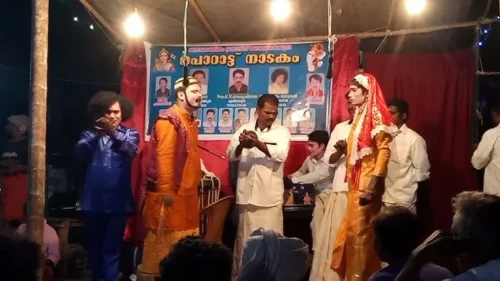
This extreme adherence to the portrayal of the common life, however, is juxtaposed with the makeshift stage on which the performance is carried out. In an almost poetic sense, the stage is called a Panthal, referring to a generic pavilion in Malayalam. Earlier, it used to be a temporary structure in the middle of an open field, kept together by Bamboo sticks and Coconut leaves, with only a few Petromaxes to light up the area. Nowadays, the coconut leaves are replaced by Tarpaulins, and LEDs provide visibility, but it is still nowhere close to the pomp and vibrancy that surround an average Classical performance.
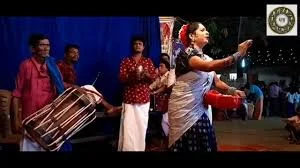
Porattu Natakam isn’t an amusical performance either. The primary instruments used as accompaniment are the Chenda (a cylindrical percussion instrument), Maddalam (a drum), and cymbals. A group of singers and musicians typically remains on the stage throughout the performance.
The Performance: The Voice of the Subaltern
If there is an inalienable part of Porattu Natakam, that would be the character of the Chodyakkaran, or the ‘Questioner.’ This character can be compared with the Vidushaka trope in Sanskrit plays or the Jesters in European court dramas, in the sense that his purpose is to anchor the silly disputes of the characters on a thematic message while exposing the hypocrisies of the society and its social norms that he inhabits. This is built upon the narrative structure of Porattu Natakam, which usually involves a domestic drama between a husband and wife (or lovers) from a specific community.
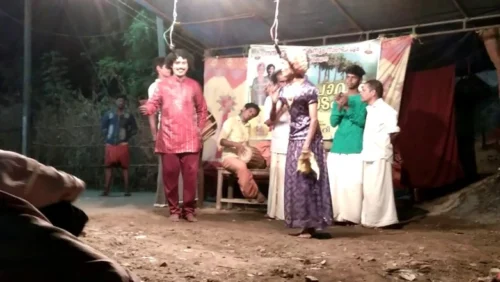
The act usually begins with the entry of the female character who contemplates the separation from her partner. She then engages the Chodyakaran to help her find him. At another instance, the male character enters the stage, engages with the Chodyakaran, and explains his side of the story. With Chodyakaran’s intervention, the couple meets, and this leads to a dialogue that often devolves into a fiery argument, fueled by the same Chodyakaran’s witty and often lewd comments. Regardless, the story concludes with the couple reconciling and leaving the stage happily together.
But how is such a basic storyline relevant to the society they live in?
That’s where Porattu Natakam outmaneuvers most of its contemporaries. The art form doesn’t function on an ‘agenda’ to send a message, but to publicize even the most ‘normal parts’ of their lives in such a way that their existence, in its raw form, will be entrenched in the public memory. They present themselves as people with their own problems, quarrels, and a sense of identity that the privileged sections of society conveniently ignored, leading to the utter dehumanization of entire groups of people for centuries, if not more.
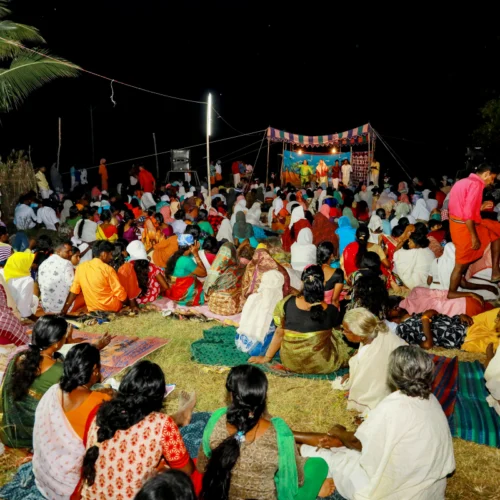
As such, when the performers went in, they went all in. Men cross-dressed as women, cobblers and manual scavengers became the ‘guest-characters,’ violence became a narrative tool, intimacy became humour, and verbal abuse became dialogue. The improvised, non-Sanskritized, unapologetic, and fearless scripts and screenplays became such a headache to the ‘piousness’ of the High and Mighty that they had no choice but to reduce the identity of Porattu Natakam to a ‘Vulgar art form.’ In other words, while the surface stories may appear to be humorous tales of lovers’ spats, the underlying narrative in all these performances was the ugly reality of the subaltern experience. The perceived vulgarity in it encapsulated the uncomfortable depictions of hunger, caste humiliation, and a fundamental struggle for survival.
In Modern Kerala
Unfortunately, Porattu Natakam has since slowly succumbed to the same oblivion it was created to escape from. It remains unfamiliar to a vast majority of Kerala’s population, and currently, there are only about two hundred artists living in and around the Palakkad district. While this could be seen as a sad side-effect of the large-scale social upliftment programs Kerala had undertaken and succeeded in, the indifference towards the erasure of the art form itself became an issue. Thus, to remain relevant, contemporary troupes have introduced significant changes to the content and structure of the performances.
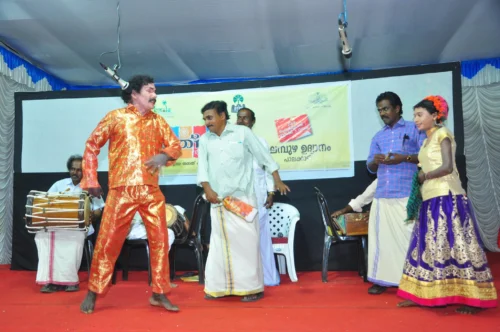
For example, while traditional acts focused on caste dynamics and daily struggles, modern performances have incorporated present social issues. Troupes have performed stories revolving around the construction of the Malampuzha Dam (perceived as an environmental hazard), and have even addressed the devastating 2018 floods in Kerala that claimed over 400 lives. What we see here is the art form expanding its ‘class-based narration’ to the possible avenues of regional and holistic well-being. The language of modern Porattu Natakam has also become more ‘sanitized’ to appeal to the modern public morality.
Conclusion
The future of Porattu Natakam is grim, and it’s not just a reaction to a changing society. Historically, Porattukalis were extremely strenuous and exceptionally improvised performances. This, combined with the long hours at night, used to take a severe physical toll on the artists, leading to the youth not being attracted to the pain-gain ratio in learning the art form. The payment received for a Porattu performance is abysmal compared to high art forms like Kathakali, so the financial motivation for the new generation to take up the art is also low. Interestingly enough, while caste-based discrimination itself is now a social taboo in Kerala, the social stigma associated with Porattu Natakam still survives in a different form, an insult that reduces its artistic value to a ‘worthless performance nobody cares about.’ For this reality to change, both the Government and the people must take active steps to preserve the fundamental features of Porattu Natakam, whether through organizing academic education, refined performances, or financial assistance.
References
-
S, SURABHI M. “THE IDENTITY OF AUDIENCE IN A KERALITE PERFORMING AREA.” University of Calicut, by SHIBU. S. KOTTARAM et al., 2019, scholar.uoc.ac.in/server/api/core/bitstreams/4b540deb-07e6-499b-b3f7-5756beec16a4/content.
- “Literatures of Resistance: Voices of the Marginalised.” International Journal of Research in Social Sciences, vol. 9, no. 5, 2019.
-
P.O. Aiswarya. “PORATTU NATAKAM; A SUBALTERN THEATRE.” Proceedings of the South Indian History Congress, vol. 38, South Indian History Congress, 2018.
- Vijayakumaran, Haritha. “Porattukali: Defying the Language of High Art.” Sahapedia
- Paanan Kali: Celebrating The Frolic and Unscripted Theatre, India Art Review